
ADHD vs. Anxiety: Why They Look Alike and How to Tell the Difference
Distinguishing between ADHD and Anxiety can be tricky since they share so many symptoms. Learn the key differences in executive function, restlessness, and focus to find the right path forward.
Karen Daniels
3/11/20262 min read


ADHD vs Anxiety: How to Tell the Difference
Attention Deficit Hyperactivity Disorder (ADHD) and anxiety are two of the most commonly diagnosed mental health conditions in adults. They can look very similar on the surface, which is why many people are misdiagnosed or live for years with the wrong explanation for their struggles.
Understanding the difference matters because treatment approaches are very different.
Why ADHD and Anxiety Are Often Confused
Both ADHD and anxiety can cause:
difficulty concentrating
restlessness
sleep problems
irritability
feeling overwhelmed
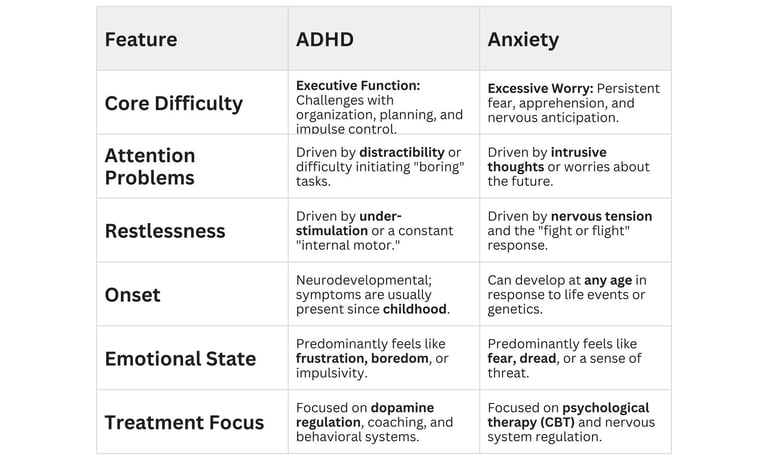
However, the reasons behind these symptoms are different.
ADHD is a neurodevelopmental condition involving differences in executive functioning such as planning, working memory, and impulse control (Barkley, 2015).
Anxiety disorders involve excessive fear and worry, often linked to threat perception and hypervigilance (American Psychiatric Association, 2022).
Because ADHD can lead to missed deadlines, disorganisation, and life stress, many people develop anxiety secondary to untreated ADHD.
Research suggests that around 40–60% of adults with ADHD also experience an anxiety disorder (Kessler et al., 2006).
When ADHD Is Mistaken for Anxiety
Many adults are initially diagnosed with anxiety because their visible symptoms include:
racing thoughts
constant worry about forgetting things
feeling overwhelmed by daily tasks
However, the underlying cause may be ADHD-related executive dysfunction.
For example, someone with ADHD may appear anxious about work deadlines. In reality, the distress is coming from difficulty organising tasks or starting them.
Once ADHD is treated, the anxiety often reduces.
When Anxiety Is Mistaken for ADHD
The opposite can also happen.
People experiencing severe anxiety may struggle to focus because their mind is preoccupied with worry. This can look like ADHD inattentiveness.
However, the key difference is that concentration problems in anxiety are usually triggered by worry, whereas ADHD attention difficulties are consistent across situations and lifelong.
ADHD can often cause anxiety because of the stress of managing executive dysfunction.
If ADHD is mistaken for anxiety, treatment may focus only on reducing worry without addressing executive function difficulties.
If anxiety is mistaken for ADHD, stimulant medication may not address the underlying fear-based symptoms.
A thorough assessment should always explore:
childhood history
functioning across different environments
patterns of attention and emotional regulation
Accurate diagnosis allows people to receive the right support and strategies.
Bibliography
American Psychiatric Association. (2022). Diagnostic and Statistical Manual of Mental Disorders (DSM-5-TR).
Barkley, R. A. (2015). Attention-Deficit Hyperactivity Disorder: A Handbook for Diagnosis and Treatment. Guilford Press.
Kessler, R. C., Adler, L., Barkley, R., et al. (2006). The prevalence and correlates of adult ADHD in the United States. American Journal of Psychiatry, 163(4), 716–723.
Willcutt, E. G., Doyle, A. E., Nigg, J. T., et al. (2005). Validity of the executive function theory of ADHD. Biological Psychiatry, 57(11), 1336–1346.
Selphie Independent ADHD Assessment Service
Selphie is an independent diagnostic service led by an NMC-Registered Mental Health Nurse. We operate in full compliance with NICE Guideline [NG87] and UK GDPR. As we provide diagnosis only (without medical treatment or prescribing), we operate independently of CQC registration, allowing us to focus entirely on providing high-quality, accessible, affordable assessments.
4a Acorn House, 13 Pollard Street, Wakefield WF3 3HG
Regulated Activity: Diagnostic and Screening Procedures
Contact: hello@selphieme.com